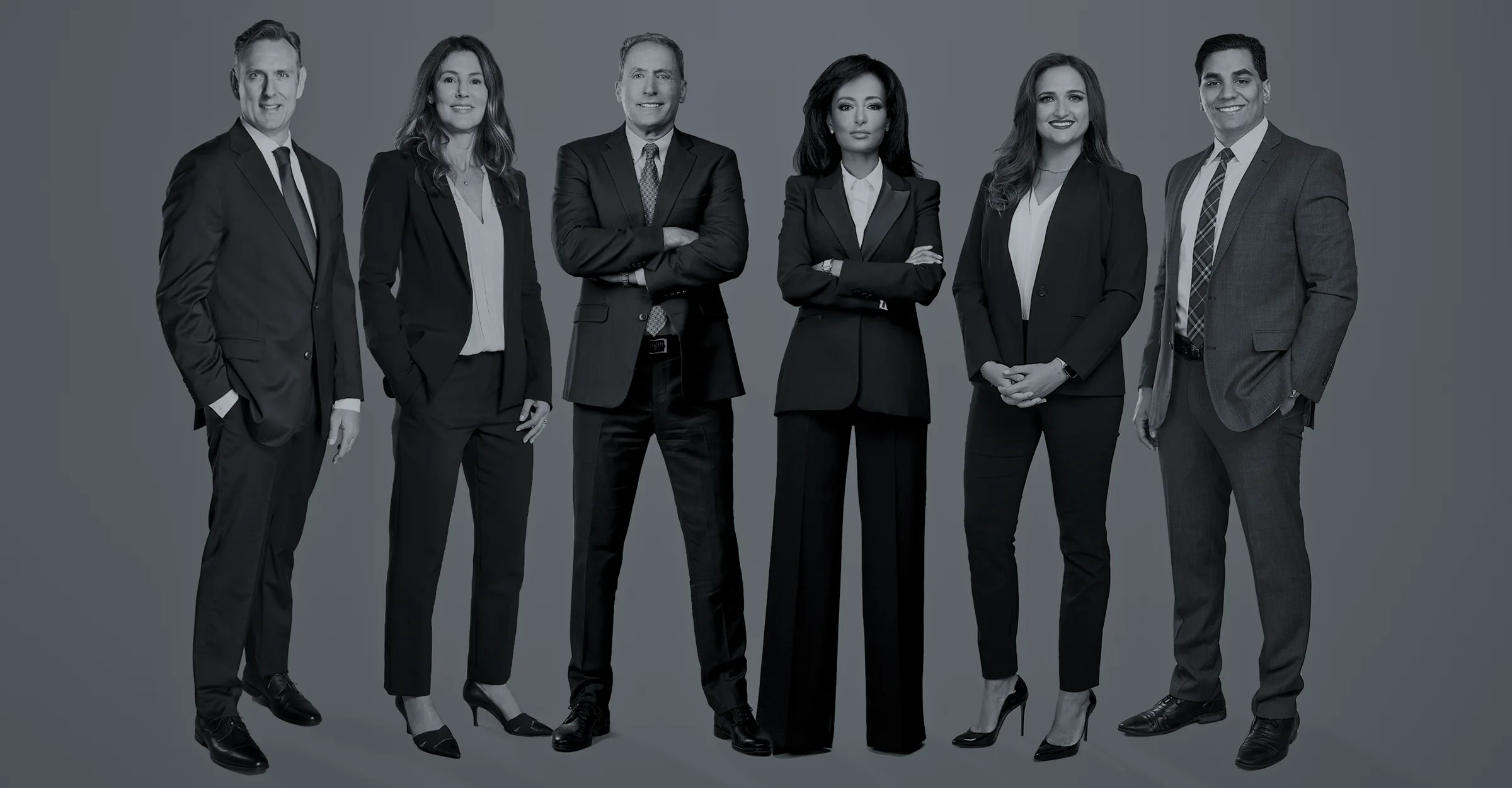
A firearm enhancement can add more time to your sentence than the underlying crime itself. In Los Angeles, if a jury finds you personally used, fired, or caused injury with a gun during certain felonies, California's "10-20-Life" law under Cal. Penal Code § 12022.53 can stack 10, 20, or 25-years-to-life onto your prison term — served consecutively. Kareem Aref, a former Deputy District Attorney who now defends the accused, brings inside knowledge of how prosecutors build and charge these enhancements at the Clara Shortridge Foltz Criminal Justice Center downtown.
Chudnovsky Law brings over 113 years of combined experience and more than 9,000 cases and trials to firearm enhancement defense across Los Angeles County. Our team includes attorneys who once charged these cases for the government — we know where the weak links are. If you or someone you love is facing a gun allegation attached to a felony, the added exposure is measured in decades, not months. Call (213) 212-5002 now for a free, confidential consultation. We answer 24/7.
On This Page:
- What 10-20-Life means
- What it costs to defend
- How PC 12022.53 works
- Related firearm charges
- Enhancement penalties compared
- Los Angeles court guide
- Our defense method
- Our promises to you
- Frequently asked questions

What Does California's 10-20-Life Law Actually Add to a Sentence?

California's 10-20-Life law adds a mandatory, consecutive prison term whenever a defendant personally uses a firearm during specified felonies. Under Cal. Penal Code § 12022.53, the enhancement is 10 years for using a gun, 20 years for firing it, and 25 years to life for causing great bodily injury or death. That time is added on top of the sentence for the underlying felony.
Here's the part that catches people off guard. The enhancement doesn't replace your base sentence — it stacks. A conviction carrying, say, a mid-term of six years for the felony can balloon past three decades once a 25-to-life enhancement attaches. And the enhancement time runs consecutively, meaning it starts only after the base term.
Enhancement is extra prison time added to a sentence because of a specific aggravating fact — here, personally using a gun. It's charged as a separate allegation the prosecution must prove to the jury beyond a reasonable doubt. Because it's a distinct finding, it's also a distinct target for the defense.
The law applies only to a defined list of qualifying felonies — serious and violent offenses like robbery, carjacking, certain assaults, kidnapping, and homicide. It does not attach to every crime involving a gun. That distinction matters enormously, because the first question we ask is whether the underlying charge even qualifies.
Since a 2018 amendment (Senate Bill 620), judges now have discretion to strike or dismiss a § 12022.53 enhancement in the interest of justice — something the law flatly prohibited for years. That single change reopened the door for negotiated and litigated relief that didn't exist before. If any of this describes your situation, a short call can tell you where you stand.
How Much Does a Firearm Enhancement Defense Lawyer Cost in Los Angeles?
The honest answer: it depends on the charge, the complexity, and whether the case heads to trial — but your first conversation with us costs nothing. Chudnovsky Law offers a free, confidential consultation where we review your paperwork, explain the exposure you're facing, and discuss fees in writing before you commit to anything.
Most matters are handled on a flat fee, so you know the total cost upfront rather than watching a meter run. For cases that require extended litigation, we offer payment plans to keep experienced defense within reach. We'll lay out the structure that fits your situation during that first call.
Consider what's actually at stake. A firearm enhancement can add 10, 20, or 25-years-to-life to a sentence. Going without skilled representation against that kind of exposure is rarely the cheaper path — the cost of getting it wrong is measured in years of your life.
Worried about cost? The first consultation is free, and we'll walk through the fee structure together. Many firearm defense matters are handled on a flat fee or payment plan so there are no surprises. Call (213) 212-5002 to talk it through.
How Does Penal Code 12022.53 Work in a Los Angeles Prosecution?
PC 12022.53 works by tying the length of the enhancement to what the defendant did with the gun, on a rising scale. The prosecution must prove, as a separate allegation, that you personally used a firearm — mere presence of a weapon or a co-defendant's gun is not enough for the personal-use tiers. Kareem Aref, who charged cases like these as a former prosecutor, focuses first on whether the "personal use" element can actually be proven.
The three tiers of the enhancement
The statute breaks down into a tiered structure. Understanding which tier the prosecution is pursuing tells you exactly how much added time is on the table.
| Conduct Alleged | Enhancement Added | How It Runs | What the DA Must Prove |
|---|---|---|---|
| Personally used a firearm | +10 years | Consecutive to base term | You displayed or used the gun during the felony |
| Personally discharged a firearm | +20 years | Consecutive to base term | You intentionally fired the weapon |
| Discharge causing great bodily injury or death | +25 years to life | Consecutive to base term | Firing the gun caused serious injury or death |
Which felonies trigger the enhancement
The enhancement attaches only to a specific list of qualifying felonies. Robbery, carjacking, assault with a firearm, kidnapping, certain sex offenses, and murder are among them. If the underlying felony isn't on the list, § 12022.53 doesn't apply — and one of the first things we examine is whether the charged offense truly qualifies.
How is 12022.53 different from the older PC 12022.5 enhancement?
Cal. Penal Code § 12022.5 is the broader personal-use enhancement that applies to a wider range of felonies but carries shorter added terms — typically 3, 4, or 10 years. Section 12022.53 is the harsher, more specific "10-20-Life" scheme reserved for the enumerated serious felonies. Which one the DA charges dramatically changes your exposure, and challenging an overreaching § 12022.53 allegation can be the difference between years and decades.
Key insight: Because the enhancement is a separate finding, a jury can convict on the underlying felony yet reject the gun allegation. We build cases that give the jury a clear, evidence-based reason to say "not true" on the enhancement even where the base charge is contested.
What Other Firearm Charges Commonly Attach to These Cases?
Firearm enhancement cases rarely arrive alone. Prosecutors in Los Angeles frequently stack possession and use charges alongside the enhancement, and each one carries its own penalty structure. Understanding every count against you — not just the headline enhancement — is central to building a defense that addresses the whole exposure.
Assault and shooting offenses
Two charges show up constantly beside firearm enhancements. Assault with a firearm under Cal. Penal Code § 245(a)(2) is a wobbler — chargeable as a felony carrying 2, 3, or 4 years in state prison (rising to 3, 6, or 9 for a semiautomatic firearm) or as a misdemeanor of not less than six months up to one year. Shooting at an inhabited dwelling or occupied vehicle under Cal. Penal Code § 246 is a felony only, punishable by 3, 5, or 7 years in state prison and counts as a strike when great bodily injury results.
Negligent discharge and brandishing
Negligent discharge of a firearm under Cal. Penal Code § 246.3 is a wobbler — as a felony, 16 months, 2, or 3 years; as a misdemeanor, up to one year in county jail. Brandishing a weapon under Cal. Penal Code § 417 is generally a misdemeanor, with a minimum jail term of 30 days for basic brandishing and steeper minimums when a firearm is brandished in public or at a peace officer.
Possession-based offenses
Felon in possession means a person with a prior felony conviction possessed a firearm — a charge under Cal. Penal Code § 29800 that is a felony punishable by 16 months, 2, or 3 years served in county jail under realignment. Carrying a concealed firearm under Cal. Penal Code § 25400 and carrying a loaded firearm in public under Cal. Penal Code § 25850 are generally misdemeanors, but become wobblers punishable by up to three years when aggravating facts apply — a prior felony, a stolen firearm, gang membership, or status as a prohibited person.
Possession of an assault weapon under Cal. Penal Code § 30605 rounds out the common list — a wobbler carrying up to one year as a misdemeanor or 16 months, 2, or 3 years as a felony. When these charges pile up, the total exposure grows fast. That's the moment to have someone in your corner who can see the whole board.
What Are the Realistic Consequences of a Firearm Enhancement Conviction?

The consequences reach far beyond the courtroom. A firearm enhancement conviction can turn a survivable felony sentence into a decades-long — or life — commitment, and it triggers a cascade of collateral consequences that follow you long after release. This is why early, aggressive intervention matters.
Prison time is only the beginning. A felony firearm conviction imposes a lifetime federal firearm prohibition under 18 U.S.C. § 922(g), stripping the right to possess a gun permanently. It can trigger immigration consequences for non-citizens, including removability under 8 U.S.C. § 1227. And for licensed professionals, a conviction of this seriousness can prompt disciplinary review by the relevant California licensing board — a consequence our firm also handles for clients whose careers are on the line.
The strike problem
Many qualifying felonies count as strikes under California's Three Strikes law. A strike doubles the base term on a future felony and can lead to a life sentence on a third qualifying conviction. When a firearm enhancement attaches to a strike offense, the compounding effect is severe.
How the enhancement and the strike interact:
A strike doubles the base felony term. The § 12022.53 enhancement then adds its own consecutive 10, 20, or 25-to-life on top of the doubled sentence. These are two separate mechanisms operating at once, which is why cases involving both demand precise, count-by-count analysis. There's no vague "multiplier" — each provision adds its own specific, quantifiable time, and each is separately challengeable.
Comparison Table: Base Felony vs. Enhanced Sentence Exposure
| Scenario | Base Term Range | Firearm Enhancement | Total Exposure |
|---|---|---|---|
| Robbery, no gun allegation | 2, 3, or 5 years | None | 2–5 years |
| Robbery + gun used (12022.53(b)) | 2, 3, or 5 years | +10 years | 12–15 years |
| Robbery + gun fired (12022.53(c)) | 2, 3, or 5 years | +20 years | 22–25 years |
| Robbery + injury caused (12022.53(d)) | 2, 3, or 5 years | +25 to life | 27 years to life |
Numbers like these are why the enhancement, not the base charge, often becomes the center of gravity in the defense. Court deadlines move fast, and the sooner we begin, the stronger the strategy we can build. Call (213) 212-5002 today.
Where Are Los Angeles Firearm Enhancement Cases Heard?
Felony firearm cases arising in central Los Angeles are prosecuted at the Clara Shortridge Foltz Criminal Justice Center at 210 W. Temple Street, the primary felony courthouse downtown, handling major felony arraignments, preliminary hearings, and trials. Misdemeanor firearm matters in the same area are often handled at the Metropolitan Courthouse on South Hill Street. Cases from the eastern communities may be heard at the East Los Angeles Courthouse, and matters arising near LAX route to the Airport Courthouse on South La Cienega Boulevard.
Local procedure and prosecution practice
Felony firearm enhancements in Los Angeles County are prosecuted by the LA County District Attorney, and charging decisions on the enhancement itself can shift with office policy. Because SB 620 gave judges discretion to strike a § 12022.53 allegation, the willingness of a particular court to exercise that discretion — and the mitigation package a defense presents — can meaningfully affect outcomes. Knowing how the enhancement is charged, negotiated, and litigated inside the downtown criminal courts is a practical advantage.
Chudnovsky Law defends cases in all 23 Los Angeles County criminal court locations, including Long Beach, Van Nuys, Pasadena, Torrance, Compton, Inglewood, Glendale, Norwalk, and Burbank. That countywide footprint means we know the tendencies and procedures across the districts where these cases land.
Why local knowledge changes the strategy
What most people miss: the same firearm allegation can be handled very differently depending on the courthouse, the assigned deputy DA, and the mitigation presented at sentencing. In our experience across thousands of cases countywide, the enhancement is frequently the most negotiable component — precisely because judges now have the discretion to strike it. Building the record for that discretion starts early, not at sentencing.
Preliminary hearing is the pretrial proceeding where a judge decides whether there's enough evidence to hold you for trial. It's an early and underused opportunity to test the strength of the enhancement allegation before a jury ever hears the case.
How Does Chudnovsky Law Defend Firearm Enhancement Cases?
We use a structured defense we call the Enhancement Deconstruction Method — a four-stage approach built to attack the gun allegation as a separate, vulnerable target rather than treating it as an afterthought to the base charge. Because the enhancement is where most of the prison time lives, that's where we concentrate the fight.
Stage 1 — Element isolation
We break the enhancement down to its required elements: personal use, personal discharge, and causation of injury. Then we ask which the prosecution can actually prove beyond a reasonable doubt. Kareem Aref, drawing on his experience charging these cases as a former Deputy District Attorney, targets the exact proof gaps prosecutors overlook — was the "use" personal, was discharge intentional, did the firing cause the injury alleged.
Stage 2 — Evidence and procedure review
We scrutinize how the firearm evidence was obtained. Fourth Amendment violations, chain-of-custody problems, and unreliable ballistics or eyewitness identification all become suppression and challenge opportunities. A successful motion to suppress — a request to exclude evidence gathered in violation of your rights — can gut the factual basis for the enhancement entirely.
Stage 3 — Charge and enhancement negotiation
With more than 9,000 matters behind us and over 100 jury trials among our attorneys, we negotiate from strength. Since SB 620, we build the mitigation and legal record needed to persuade a court to strike or dismiss the enhancement in the interest of justice, and we pursue reductions where the evidence on the gun allegation is weakest.
Stage 4 — Trial readiness
We prepare every case as if it's going to trial before the Foltz Criminal Justice Center. That posture — real courtroom experience, not just plea negotiation — is what gives negotiations their weight. Prosecutors treat trial-ready defense teams differently.
Not sure where you stand? That's exactly what a free consultation is for. No pressure, no obligation — just honest answers about your options. Call (213) 212-5002.
What Are Chudnovsky Law's Commitments to You?

We make three concrete promises — not slogans, but commitments you can hold us to.
First, prompt access. When you call (213) 212-5002, you reach a real person 24/7, and we respond quickly because firearm cases move fast and early decisions shape everything that follows.
Second, a named attorney on your case. You won't be handed off to a rotating cast. An experienced defense attorney from our team — led by attorneys with genuine trial and former-prosecution backgrounds — handles your matter and keeps you informed at every stage.
Third, transparent fees. We discuss cost in writing during your free consultation. Many firearm matters are handled on a flat fee, and payment plans are available, so you know what you're paying before you retain us.
Our team's standing reflects this approach: a 10.0 Superb rating on AVVO, Super Lawyers Rating, five-star reviews across Google in Los Angeles, Orange County, and Long Beach, and recognition among the Top 100 Trial Lawyers by the National Trial Lawyers Association.
This page covers California state firearm sentencing enhancements — primarily PC 12022.53 and PC 12022.5 — and the related state charges that commonly accompany them. It is not a substitute for advice on a specific federal firearm prosecution or a civil matter; those require individualized counsel.
The information on this page is for general informational purposes and does not constitute legal advice. Every case is unique, and past results do not guarantee future outcomes. Contact a qualified attorney to discuss your specific situation.
Facing 10, 20, or 25-years-to-life from a firearm enhancement is not a fight to face alone. The exposure is measured in decades — and the window to build a strong defense narrows with every passing day. Call Chudnovsky Law at (213) 212-5002 for a free, confidential consultation. We answer 24/7 and defend clients throughout Los Angeles County.
Frequently Asked Questions
Will I go to prison if I'm convicted of a firearm enhancement?
A firearm enhancement under PC 12022.53 carries mandatory consecutive prison time of 10, 20, or 25-years-to-life, added on top of the sentence for the underlying felony. However, since a 2018 change in the law (SB 620), judges now have discretion to strike or dismiss the enhancement in the interest of justice. Whether that relief is realistic depends heavily on the facts, your record, and the mitigation presented — which is why early legal help matters.
How much does a firearm enhancement defense lawyer cost in Los Angeles?
Your first consultation with Chudnovsky Law is free and confidential. Most firearm defense matters are handled on a flat fee so you know the total cost upfront, and payment plans are available for cases requiring extended litigation. We discuss the fee structure in writing during your first call, before you commit to anything.
What's the difference between PC 12022.53 and PC 12022.5?
PC 12022.5 is a broader personal-use firearm enhancement applying to many felonies, carrying added terms of roughly 3, 4, or 10 years. PC 12022.53 is the harsher "10-20-Life" scheme reserved for a specific list of serious felonies, adding 10, 20, or 25-years-to-life. Which one the prosecution charges dramatically changes your exposure, and challenging an overreaching 12022.53 allegation can be central to the defense.
Can a firearm enhancement be dismissed or reduced?
Yes, it's possible in certain circumstances. Since SB 620 took effect, judges can strike a PC 12022.53 enhancement in the interest of justice. Enhancements may also be defeated at trial, because the jury must find the gun allegation true separately from the underlying felony. We build the legal and mitigation record needed to pursue reductions or dismissal where the evidence on the gun allegation is weakest.
What does "personally used a firearm" actually mean?
Personal use means the defendant themselves displayed, used, discharged, or caused injury with the gun during the felony. The mere presence of a weapon, or a co-defendant's use of a gun, is generally not enough for the personal-use tiers of PC 12022.53. This element is a frequent point of attack, because the prosecution must prove your personal conduct beyond a reasonable doubt.
Does a firearm conviction affect my right to own a gun?
Yes. A felony firearm conviction imposes a lifetime federal firearm prohibition under 18 U.S.C. § 922(g), permanently barring you from possessing a gun. California law imposes similar prohibitions. These restrictions apply on top of any prison sentence and are among the lasting collateral consequences of a conviction.
What if the firearm enhancement is attached to a strike offense?
Many qualifying felonies for PC 12022.53 also count as strikes under California's Three Strikes law. A strike doubles the base felony term, and the firearm enhancement then adds its own consecutive time on top of that doubled sentence. These two mechanisms operate separately and both are individually challengeable, so a precise count-by-count analysis is critical.
How long does a firearm enhancement case take in Los Angeles?
Timelines vary widely based on complexity, whether the case resolves through negotiation, and whether it proceeds to trial. Felony cases involving enhancements can take many months to well over a year, moving through arraignment, preliminary hearing, pretrial motions, and potentially trial at the Clara Shortridge Foltz Criminal Justice Center. The timeline runs whether or not you have counsel — the difference is what representation does with that time.
Which court will hear my firearm case?
Felony firearm cases from central Los Angeles are typically heard at the Clara Shortridge Foltz Criminal Justice Center downtown, while related misdemeanors go to the Metropolitan Courthouse. Cases from other communities may be heard at the East Los Angeles Courthouse or the Airport Courthouse near LAX. Chudnovsky Law handles cases in all 23 Los Angeles County criminal court locations.
Do I really need a lawyer for a firearm enhancement charge?
Given that a single enhancement can add 10, 20, or 25-years-to-life to your sentence, experienced defense is strongly advised. The enhancement is a separate allegation with distinct elements that must be proven — and distinct opportunities to attack. A skilled attorney can challenge the evidence, litigate suppression motions, and build the record needed to seek dismissal or reduction. Call (213) 212-5002 for a free case review.
Chudnovsky Law - Los Angeles Office
Address: 1933 S Broadway #1100, Los Angeles, CA 90007, USA
Contact No: (213) 212-5002
